
The Black Swan Is Boring
Why Disclosure Won’t Be a Hollywood Spectacle

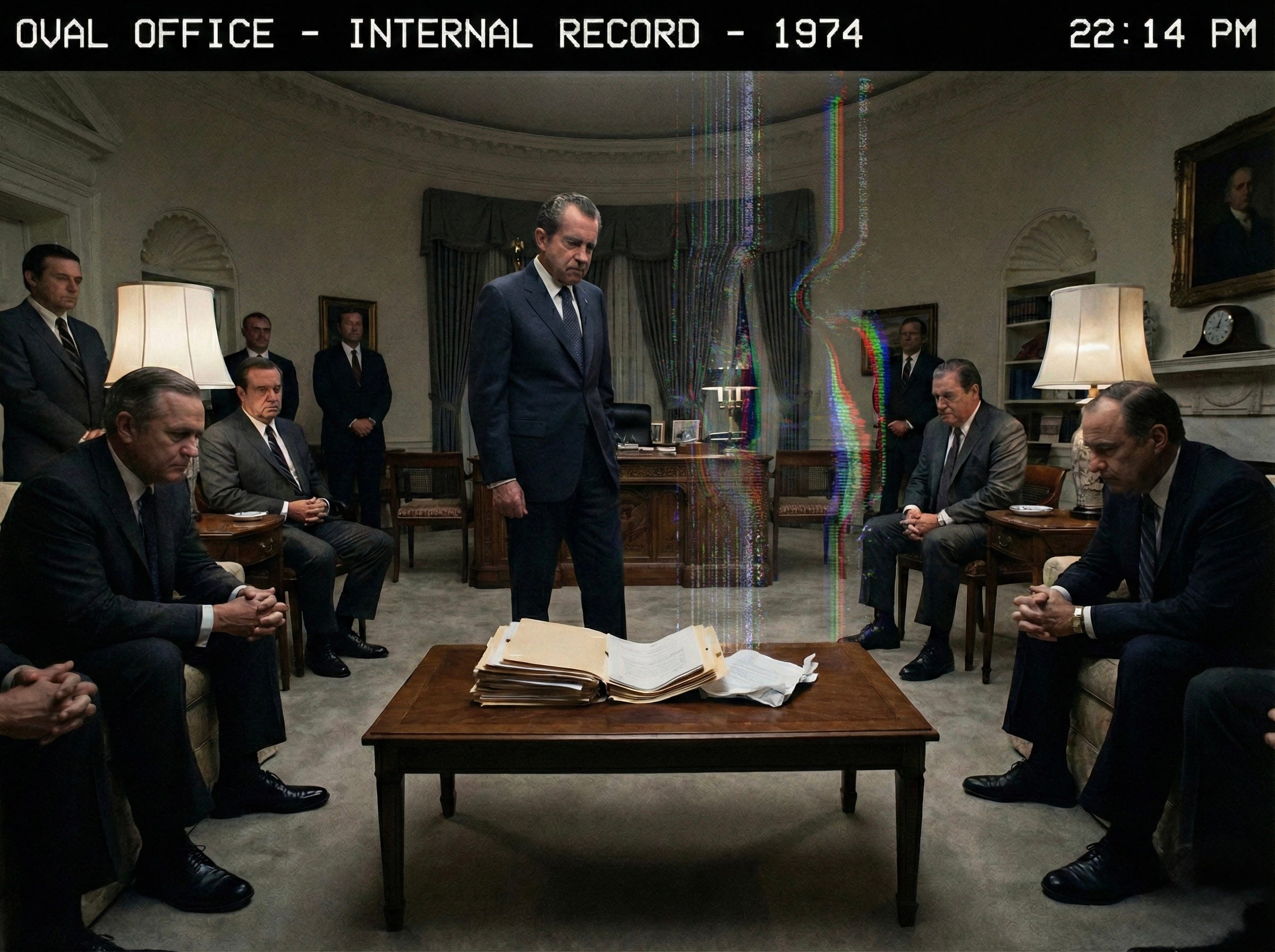
Series: The Boundary Conditions (3/3). You’re here: why disclosure won’t be a Hollywood spectacle, but instead an administrative collapse. Prev: Chasing Zero. (Each essay stands alone.)
Everyone waits for spectacle: the saucer on the White House lawn, the broadcast that interrupts the Super Bowl, the single moment so theatrical that denial collapses under its own embarrassment.
That expectation is exactly why nothing ever arrives that way. Spectacle is easy to absorb. It lives in the narrative layer, where evidence degrades under incentives, interpretation, and argument. Anything that looks dramatic can be reclassified as error, hoax, or confusion and safely metabolized.
The black swan, if it comes, will be boring. It will not announce itself. It will arrive as a failure no one can sign off on—not a sighting, but a liability. Not revelation, but a breakdown in the systems that let institutions agree on what is real.
What does not degrade is the calibrated substrate that civilization depends on to function: clocks, ledgers, entropy monitors, verification procedures. If the phenomenon is real, it does not need to win a debate. It needs to create a condition that cannot be booked, waived, or reclassified without someone signing a lie.
The usual black swans are the wrong target. A crash, a body, a broadcast, or a spectacular sighting still lives in the narrative layer, which means it can be downgraded. To break the engine, the target must shift from belief to custody. If denial persists because anomalies remain bookable as ordinary error, then the only engine-breaking anomalies are the ones that create un-bookable liability across independent custodians.
What follows are four audit-shaped thought experiments. Each targets a substrate civilization depends on and treats the anomaly as a certification failure. If any of these survives hostile replication, the result is not unity. It is forked admissibility: institutions fracturing over what counts as evidence and what can still be certified.
Civilization is not held together by shared beliefs. It is held together by calibrated services. When those services fail, the consequence is not wonder. It is paperwork. Paperwork creates signatories. Signatories create liability. Denial ends at the signature line, when certification becomes the risk.
Thought Experiment I: The Clock That Refuses to Agree
Time in civilization is not a flow; it is a legal agreement. Global markets and telecommunications depend on a shared fiction that we all agree on what “now” is.
The relevant anomaly, then, is not a time warp. It is a lawsuit.
Imagine a moment where two major stock exchanges cannot agree on who traded first. The dispute isn’t nanoseconds of jitter; it is a sustained disagreement that lasts for minutes. One clock says A came before B. The other clock says B came before A. Both clocks pass their internal diagnostics.
A physicist might call this relativity. A banker calls it a broken contract.
The skeptic will claim it’s a software bug or a routing error. That is the correct first move. But if you strip the system down—bypass the software, use hard lines, isolate the hardware—and the disagreement persists, you have left the realm of IT support. You have entered a reality where the sequence of events is no longer objective.
You won’t get a press conference about time travel. You will get a frozen market. The liability of a world where “before” and “after” are local opinions is infinite. The system simply stops trading.
Thought Experiment II: The Coin That Only Flips Heads
Randomness is the bedrock of security. We build systems that assume entropy is real. If randomness fails, encryption fails.
The defense against this is radical simplicity. To rule out hidden bugs, you need a control that is too dumb to have them. Build a noise source from a fifty-cent diode and a standard amplifier—hardware so basic it cannot be “hacked.” If this raw analog rig goes haywire at the exact same moment as the certified system, the skeptic loses their favorite exit. It isn’t the code. It’s the physics.
If the anomaly survives on that dumb hardware, the technical excuses die. You aren’t arguing about ghosts anymore; you are reporting a malfunction. The verdict becomes operational, not metaphysical: the certified source has failed its mandated entropy requirement.
Thought Experiment III: The Ledger That Won’t Balance
Civilization emits administrative exhaust. Every person leaves a wake of transactions, location pings, and biological consumption. When people vanish, they usually reappear in another column of the ledger.
The anomaly here is not a ghost story. It is an accounting error that refuses to close.
Consider a cohort of people who vanish from the grid. The usual explanation is that they want to be lost, or they are dead. But statistics are stubborn. If you track a specific group—say, insulin-dependent diabetics who physically cannot survive thirty days without a supply chain—and they disappear without a death certificate and without filling a prescription, the model breaks.
We have systems designed to catch tax cheats and insurance fraud that track exactly this kind of data. If those systems return a “residual”—a group of people who are neither present nor dead, who have exited the economy without exiting biology—you don’t have a mystery. You have a population that the state cannot certify exists.
The horror isn’t that they are gone. The horror is that the math says they should still be here, and the ledger refuses to balance.
Thought Experiment IV: The Impossible Prediction
This is the Feynman test: “You must not fool yourself, and you are the easiest person to fool.”
The anomaly is a prediction that comes true when it physically shouldn’t. In cryptography, we call this a binding commitment: I put a secret in a box, you do something random, and then I open the box to prove I knew what you would do.
If a “visitor” or a phenomenon can perform this trick—consistently predicting a random output generated by a machine they cannot touch—the implications are devastating. It doesn’t mean they are magic. It means they are operating from a vantage point where our “randomness” looks like a script they have already read.
It breaks the assumption of fair play. If the casino knows the card order before the shuffle, the game isn’t mysterious. It’s rigged. And civilization cannot sign a contract with a rigged deck.
How This Collapses
There is a clean way for this argument to fail. If time priority becomes defensible again after declared corrections, if entropy holds under pre-registration, if the residual disappears after linkage and lag corrections, if the verification case fails under adversarial reproduction, then there is no engine to break here. There is only engineering and my own appetite for pattern.
What Disclosure Actually Looks Like
If any of the above survives hostile replication, do not expect unity. Expect forked admissibility instead—different institutions certifying different realities.
Institutions do not converge on truth. They converge on what they can certify. When calibration is contested, consensus mechanisms fracture. The split does not happen in a conference hall. It happens when a contract fails to settle.
The public does not get revelation. It gets competing compliance regimes.
Disclosure is not a moment of wonder. It is a moment of administrative insolvency.
Why This Matters Now
This argument would have been academic twenty years ago. It is not now. Civilization has compressed its coordination systems until tolerance for ambiguity is thin and shrinking. Markets operate at microsecond resolution. Cryptography underwrites everything from commerce to sovereignty. Identity, benefits, and risk are reconciled continuously rather than episodically.
That means the ambiguity engine no longer needs a miracle to break. It only needs an ordinary failure that arrives in the wrong place, at the wrong scale, with no safe downgrade available.
If something truly resists closure, it will not reveal itself by impressing us. It will reveal itself by forcing institutions to choose between pretending nothing happened and admitting they cannot certify reality anymore.
Appendix: Related Ideas, Narrowly Scoped
Variants of these intuitions appear elsewhere, but usually as local arguments rather than a general mechanism for disclosure. Some writers, including Greg Scaduto, have framed UAP disclosure pressure as an accounting or compliance problem. Others have cataloged phenomenological anomalies in time, electromagnetism, or perception. Still others have argued the phenomenon resists closure by design.
None proposes the framework developed here: engine-breaking anomalies defined as un-bookable liability across independent custodians. This appendix acknowledges adjacency, not derivation.
If you start noticing failures that don’t reconcile, you’re already watching the right thing.